
Reviewed · GUIDED WALKS IN STOCKHOLM
Beautiful Stockholm Small Group Walking Tour
A walk in Stockholm that feels like a guided storybook.
This small-group route strings together royal power, civic life, and medieval streets, with stops timed for quick photos and clear explanations. I love how the route hits major landmarks without dragging, and I also like that the guide style is friendly and uses visual aids to make the architecture and politics make sense.
One thing to plan for: it is a steady 1 hour 45 walk at a moderate fitness level, and Stockholm weather can turn windy fast, especially around the palace viewpoints and bridges.
In This Review
- Key highlights before you start
- Why this Stockholm walking tour feels efficient in 1 hour 45
- Start at Gustav Adolfs torg, then the Royal Swedish Opera connection
- Riksdagshuset, where Swedish politics moved from estates to voting
- Riksbron bridge views: politics, power, and the Nobel banquet angle
- Lejonbacken: one of the best photo moments near the Royal Palace
- Slottsbacken and Palace Chapel: the royal courtyard side of the story
- Stortorget: Bloodbath of Stockholm, then Nobel Prize Museum in the same square
- Through Gamla stan lanes to Skeppsbron: the street layout that shaped trade
- What to expect from the guide, pacing, and small-group setup
- Where it ends, and how to keep the day rolling toward Djurgården
- Should you book this Stockholm small group walk?
- FAQ
- How long is the Beautiful Stockholm Small Group Walking Tour?
- What does the tour cost per person?
- Is the tour offered in English?
- How many people are in the group?
- Where does the tour start and end?
- What stops are included during the walk?
- Are admission tickets required for the stops?
- What should I do with my ticket?
- What fitness level do I need?
- Is there free cancellation?
Key highlights before you start
- Small group size (max 10), so questions and pace stay human.
- Royal Swedish Opera to Gamla stan in one smooth line, no bus hopping needed.
- Neo-Renaissance and Neo-Baroque government buildings explained in plain language.
- Riksbron bridge views across to Knights Island, the Prime Minister’s residence, and the City Hall area.
- Top photo stops at Lejonbacken and the Karl XII statue area.
- Old Town lanes to Skeppsbron, with a focus on what life looked like centuries ago.
Why this Stockholm walking tour feels efficient in 1 hour 45
At $106.42 per person for about 1 hour 45, you are paying for two things: time with a guide who can explain what you are looking at, and a route that keeps you from wandering in circles. Rough math makes it about $61 an hour, which is fair for a guided walking experience when you consider how much ground you cover and how many key sights you hit in that window.
This isn’t a slow “point and photograph” loop. The tour keeps moving with short stops, usually around 10 to 20 minutes each, which is exactly what you want when daylight changes quickly in northern cities. Also, you do not need to hunt for locations. The walk is built around recognizable anchors, from Gustav Adolfs torg to the royal palace area and then into Gamla stan.
And because it is capped at 10 travelers, the guide can adjust if you have questions about buildings, symbols, or why certain places matter. That small-group feel is one of the most practical parts of the experience, not just a nice extra.
More Guided Walks in Stockholm
Start at Gustav Adolfs torg, then the Royal Swedish Opera connection
You begin at Gustav Adolfs torg, an easy central starting point that keeps the walk from feeling complicated. From there, the tour opens with the Royal Swedish Opera, a great first stop because it sets the tone: this city is full of royal references, and you will see them again and again.
You get a quick introduction to Sweden and Stockholm, including the idea that Sweden’s formal name is Kingdom of Sweden. From that first framing, the places around the square start to click, not just as pretty buildings but as part of a power story.
What I like here is the specific cultural tie. The opera house appears in The Masked Ball, composed by Giuseppe Verdi, and the opera connects to the Swedish king Gustav III. That gives you a hook for understanding why these grand institutions were built and how they were used to shape public identity.
Even better, the tour lists the stop as admission ticket free, so you can focus on looking and listening rather than pricing out every entrance.
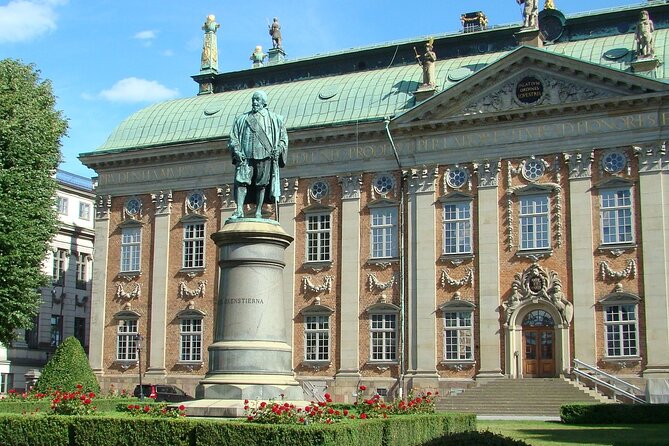
Riksdagshuset, where Swedish politics moved from estates to voting
Next up is the Parliament Building, the Riksdagshuset. If you usually walk past government buildings and feel nothing, this stop is designed to fix that. You learn the look of the building is part of its message. It is described as Neo-Renaissance in design, with a Neo-Baroque facade section. That means you are not just seeing style, you are seeing a statement.
The tour places it in time too. The building was constructed between 1897 and 1905, which helps you understand that the modern Swedish state has a specific arrival date in architecture, not only in ideas.
Then you get the political timeline, in a way that is easy to picture:
- The earlier institution was the Riksdag of the Estates (Ståndsriksdagen), where the nobility, clergy, burghers, and peasants met separately before meeting the king.
- That system was dissolved in 1866.
- A two-chamber parliament came in after that, but without equal voting rights for all citizens.
- The first elections with general suffrage happened in 1921, after a political struggle led by liberals and socialists.
- In 1975, the constitution changed and the two chambers merged into one, with the king becoming representative rather than holding real power.
For me, that sequence is the payoff of the stop. It turns a building facade into a map of how Sweden’s democracy developed.
The tour also lists this as admission ticket free, so you spend your time on explanation and views rather than entry lines.
Riksbron bridge views: politics, power, and the Nobel banquet angle
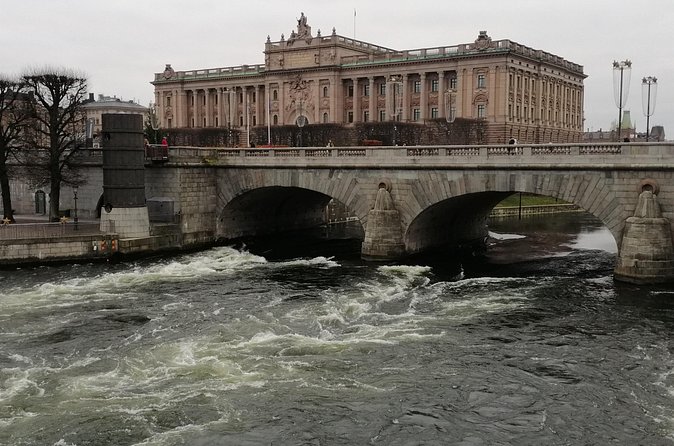
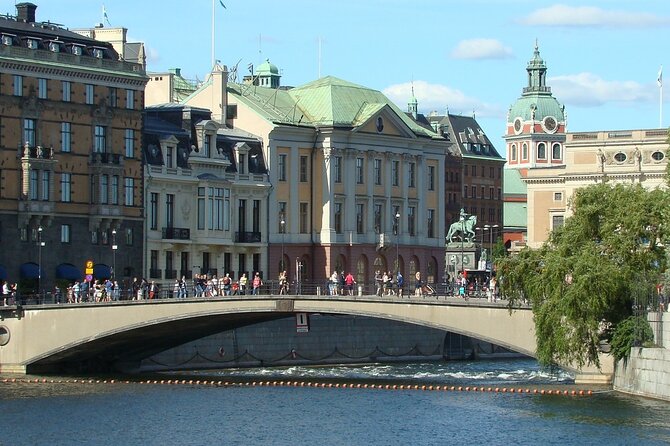
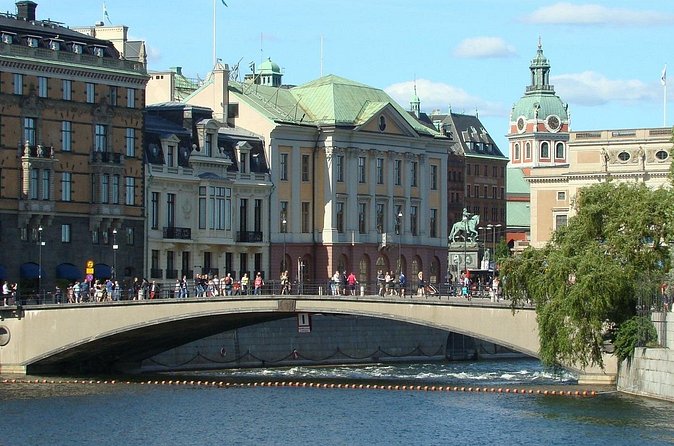
At Riksbron, you get one of those Stockholm moments where a single bridge view tells you a lot. From here, you can marvel at the Knights Island and key seats of governance, including the Prime Minister’s residence and government building, plus the House of Nobility area.
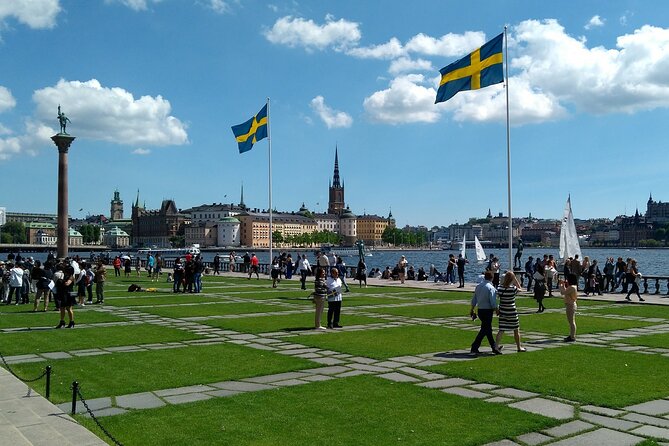
The tour also points out the City Hall, where the yearly Nobel prize banquet happens. This is a smart connection because it is not only about politics and parliament. It is about how Stockholm’s institutions support major international traditions, and how those traditions sit right inside everyday city space.
Why this matters for your trip: when you later see the Nobel Prize Museum in Old Town, this viewpoint gives you context. You will understand the city is not doing a separate “history museum” thing, the symbols are tied together across districts.
This stop is also listed as admission ticket free. Since the time is built for quick sightlines, dress for the conditions. Wind can pick up, and standing still on a bridge is not the moment to realize you packed the wrong layer.
Lejonbacken: one of the best photo moments near the Royal Palace
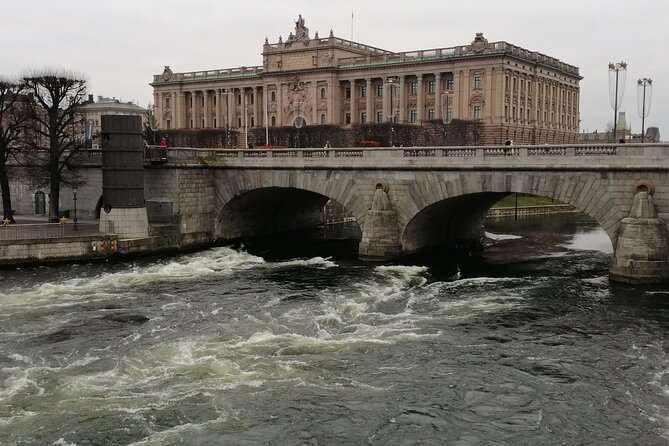
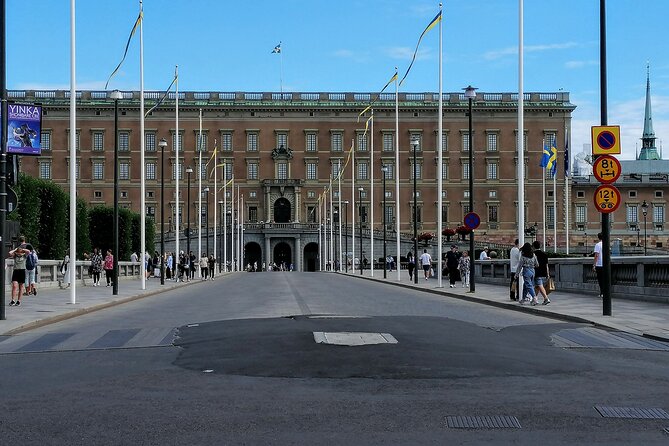
Lejonbacken is on the north side of the Royal Palace, and it is one of the most popular photo spots for a reason. You get time here to take pictures, but also time to understand what you are photographing.
The tour connects the area to Sweden’s period as a major Northern European power in the 17th and 18th centuries. Then it adds a concrete landmark: a statue of Karl XII in the Royal Garden. Karl XII is presented as the last of the Swedish warrior kings, and it makes the garden feel less like decorative greenery and more like a memory marker.
To the right of the park, you also look toward the Financial District built around the turn of the 20th century, described as a flowering of architectural styles. That contrast is part of the fun of Stockholm. You are not only looking at one century at a time. You’re seeing how the city kept reinventing itself.
The stop also calls out the Grand Hotel, described as the most prestigious hotel in Stockholm, where Nobel laureates stay when they come for the Nobel prize ceremonies. Again, this is a pattern you will see across the walk: Nobel culture shows up as real geography, not a distant idea.
The tour lists admission ticket free, and the time allocation (about 15 minutes here) is perfect for a few photos, a quick look around, and moving on before you overheat or get soaked.
Same daylight, a different plan:
- Stockholm: ABBA The Museum Entrance Ticket
★ 4.7 · 11,280 reviews - Stockholm: City Archipelago Sightseeing Cruise with Guide
★ 4.3 · 10,798 reviews - Stockholm: Skansen Open-Air Museum Admission Ticket
★ 4.5 · 3,427 reviews
Slottsbacken and Palace Chapel: the royal courtyard side of the story
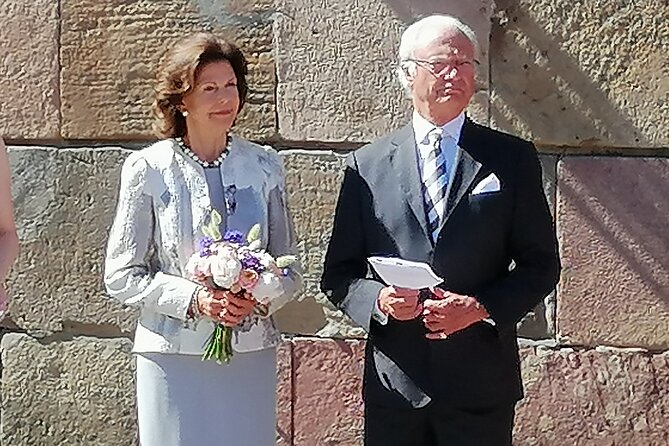
After Lejonbacken, you pass along Slottsbacken and into the inner courtyard area of the Royal Palace. This is a different kind of royal experience. Instead of only looking outward at monuments, you get a short visit to Palace Chapel, where the royal family baptizes their children.
That detail is useful because it grounds the palace in family life and ceremonies, not only state pageantry. The palace becomes a living institution.
Outside, you also stop for the statue of Carl XIV Johan. The tour explains his path clearly: he made a career in Napoleon’s army, was adopted into the Swedish royal family, and was the first from the Bernadotte dynasty, described as the longest royal dynasty in the world still ruling.
Then the tour offers a practical context shift for his reign. Carl XIV Johan is said to have been imported from France to win back what was lost to the Russians in the Napoleonic wars. The story is that diplomacy and improvements to infrastructure and education took center stage instead.
The tour ties Sweden’s modern foundation to peace and development, including the idea that in 2014 Sweden celebrated 200 years of peace, and that the welfare state was supported by industrial revolution, natural resources, and Swedish inventions.
You might not remember every year after your walk, but you will remember the way the guide turns statues into cause-and-effect stories. It is one of the best “wait, now I get it” moments on the route.
Stortorget: Bloodbath of Stockholm, then Nobel Prize Museum in the same square
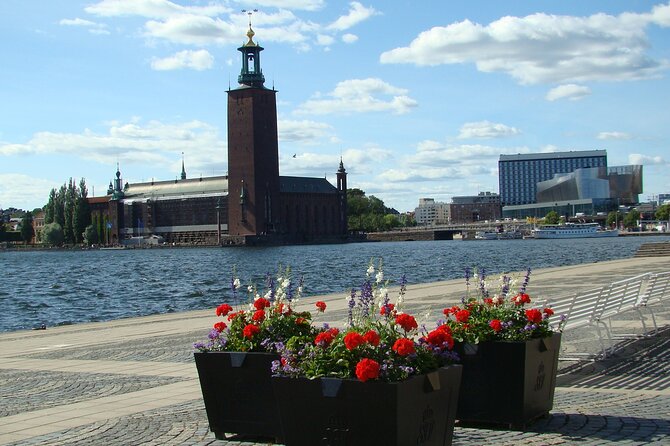
Next is Stortorget, the central square in Old Town and the most photographed place in Stockholm. The square is surrounded by houses in 17th-century Scandinavian Renaissance and 18th-century Classicism styles, so even if you only glance at buildings, you are still surrounded by architectural clues.
Then the tour hits you with a darker chapter: the Bloodbath of Stockholm in November 1530. Around 100 noblemen and priests were beheaded by the Danish king Christian II, who is known in Sweden as Christian the tyrant. This stop does not sugarcoat the past, but it gives you a reason to look carefully at the square instead of treating it like a photo backdrop.
Right here, you also find the Nobel Prize Museum at Stortorget. The tour notes that the Swedish Royal Academies and other committees designate winners of prestigious prizes in many fields, including science and art.
This pairing is powerful for your understanding. You see the same square handle both serious political violence and global intellectual recognition. Stockholm is not afraid to place the Nobel story in the shadow of older events.
The time is about 15 minutes and listed as admission ticket free, so the focus stays on what you can see from street level and what the guide connects for you.
Through Gamla stan lanes to Skeppsbron: the street layout that shaped trade
From Stortorget, you walk Köpmangatan, Merchants Street. The tour says the street has been mentioned in written material since 1350, which gives you a real sense of continuity. Even if you do not care about dates, it helps you picture how long this city has been moving goods and people through these narrow passages.
You also go through narrow alleyways designed to help you feel the medieval atmosphere. Then you walk along Österlånggatan and head down toward Skeppsbron, where ships have loaded cargo since the 17th century.
Why I like this section: it is where you stop being a spectator and start being a walker. Stockholm’s Old Town is not only about big buildings. It’s about the shape of movement, the pinch points, and the way a street funnels you down to the water.
The tour lists this as admission ticket free and schedules around 20 minutes for the Old Town segment. That timing helps you enjoy the lanes without turning the walk into a full-day maze.
What to expect from the guide, pacing, and small-group setup
This tour is run by Stockholm DriveAndGuide and is offered in English. The pacing is designed for moderate walking fitness, and the route is close to public transportation, which is a comfort if you want options before or after.
The small group size matters more than you might think. With a cap of 10 people, you are more likely to get personal explanations on what matters to you. And one standout theme from the experience style is that the guide explains architecture clearly and uses visual aids to make details easier to spot.
Also, expect short time slots rather than long “stand and stare” moments. Each major stop gets a defined bite of context, then you move. It is a smart format for people who want to see a lot but hate feeling rushed.
Finally, pack for weather. The route includes bridges and palace viewpoints, and wind can be a real factor in Stockholm. Layers and a hat that can handle gusts will save your mood.
Where it ends, and how to keep the day rolling toward Djurgården
The tour ends at the Karl XII statue area, specifically near Karl XII:s torg 9, 111 47, and the route concludes at the southern end of Kungsträdgården.
This is a practical finish. From there, the tour notes that it is possible to take the tram to Djurgården, the island of museums. If you want a next step right after the walk, that is a smooth continuation toward places like the Vasa museum, Viking museum, ABBA museum, and Skansen (outdoor museum).
So you can book this as your first big historic orientation, then choose a museum stop based on your mood.
Should you book this Stockholm small group walk?
Yes, if you want a guided route that connects royal buildings, Swedish political development, and Old Town streets without requiring museum ticket planning. The small group size, the English delivery, and the way the guide uses visual aids are strong reasons to choose it, especially if you like learning what you see instead of just taking photos.
It may not be your best match if you dislike walking for about 1 hour 45 or if you need a very quiet pace with long stops at each site. This walk is built for movement and momentum.
If your goal is to get oriented in Stockholm and leave with a clearer mental map of the monarchy, parliament, Nobel references, and Gamla stan’s street layout, this is a solid value pick for the time you have.
FAQ
How long is the Beautiful Stockholm Small Group Walking Tour?
It lasts about 1 hour 45 minutes.
What does the tour cost per person?
The price is $106.42 per person.
Is the tour offered in English?
Yes, the tour is offered in English.
How many people are in the group?
The tour has a maximum group size of 10 travelers.
Where does the tour start and end?
It starts at Gustav Adolfs torg, 111 52 Stockholm, Sweden. It ends near the Karl XII statue at Karl XII:s torg 9, 111 47 Stockholm, and finishes at the southern end of Kungsträdgården.
What stops are included during the walk?
Key stops include the Royal Swedish Opera, the Parliament Building (Riksdagshuset), Riksbron, Lejonbacken, Slottsbacken, Stortorget, and the Stockholm Old Town area through to Skeppsbron.
Are admission tickets required for the stops?
The itinerary lists the stops as admission ticket free.
What should I do with my ticket?
You’ll receive a mobile ticket.
What fitness level do I need?
The tour notes a moderate physical fitness level is recommended.
Is there free cancellation?
Yes. You can cancel up to 24 hours in advance for a full refund. Cancellation less than 24 hours before the start time is not refunded.
New on the Stockholm pages
- Stockholm Tour + Drottningholm Palace by VIP car PRIVATE Guide★ 5.0 · 1 review
- Discover Stockholm’s Christmas Market Magic with a Local★ 5.0 · 1 review
- Deluxe Stockholm Tour with Vasa Museum from Cruise Port★ 4.0 · 1 review
- First Class Airport Limousine Transfer: Arlanda Airport to Stockholm City★ 5.0 · 1 review
- Stockholm Shore Excursion from Cruise Port★ 5.0 · 1 review
- Stockholm Old Town Walking Tour + Archipelago Cruise★ 5.0 · 1 review
- Stockholm History Walking Tour★ 5.0 · 1 review
Guided Walks in Stockholm, compared.
Stockholm Gamla Stan: Old Town Walking Tour with Local Guide
Read our review →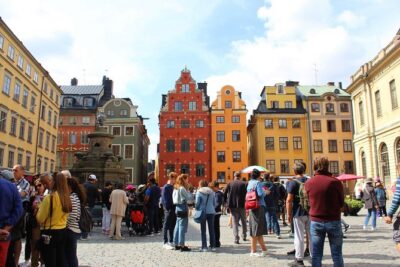
The Original Stockholm Ghost Walk and Historical Tour – Gamla Stan
Read our review →
Best of Stockholm Walking Tour-3 Hours, Small Group max 10 people
Read our review →
Browse the lists this tour appears in